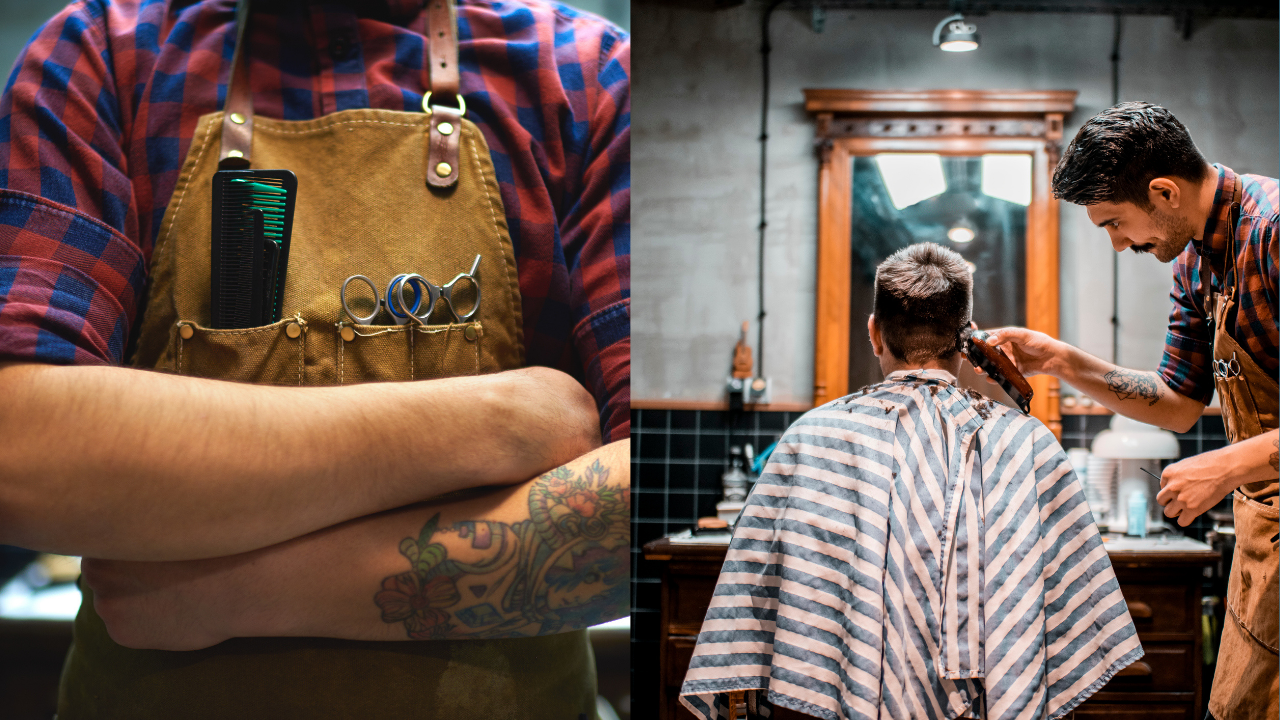
Walk into a well-run barbershop and you feel the music before you consciously register it. The energy in the room, the pace of conversation, the way clients settle into the wait, whether the barbers move with momentum or drag, is partly a function of what is coming out of the speakers. Most barbershop owners understand this intuitively. Far fewer have a deliberate system for it. This is a guide to building one.
A barbershop playlist that keeps chairs turning runs at 100 to 118 BPM during peak hours, reflects the specific cultural identity of the shop, and maintains volume high enough to energize the room without drowning out the conversation that makes barbershop visits worth coming back for. The music is not background, it is part of what your clients are paying for.
What Does the Music Actually Do in a Barbershop?
A barbershop operates differently from almost every other personal care environment. The relationship between barber and client is often long-term and conversational in a way that salon appointments rarely are. Clients come in not just for the cut but for the room, the energy, the talk, the particular feeling of that specific shop. Music is load-bearing infrastructure for that experience.
On the operational side, tempo has a measurable effect on service pace. Research by Ronald Milliman, published in the Journal of Marketing (1982), established that music tempo influences behavioral pace in commercial environments. Higher tempo music correlates with faster movement, quicker decisions, and higher throughput. In a chair-based service business, this matters: a shop running at 95 BPM during peak Saturday hours will move clients through the queue at a different rate than one running at 75 BPM, all else equal.
This does not mean louder and faster is always better. Volume that makes conversation difficult reduces the social value of the visit, the part clients will describe to their friends. The goal is tempo that creates momentum without volume that creates strain. Research by Guéguen, Jacob, and Le Gouëff, published in Alcoholism: Clinical and Experimental Research (2008), found that high volume accelerated consumption pace but at the cost of the quality of the social environment. The same trade-off exists in a barbershop: maximum throughput is not the same as maximum satisfaction.
How Do You Match the Music to Your Shop's Identity?
There is no universal barbershop playlist because there is no universal barbershop. The sound of a classic straight-razor shop in a downtown hotel is not the sound of a neighborhood shop in a historically Black community, and neither is the sound of a premium men's grooming studio targeting a financial district clientele. The music that works is the music that is true to what the shop actually is, not what some generic "barbershop playlist" on a streaming service decided it should be.
| Shop Identity | BPM Range | Core Genres | Avoid |
|---|---|---|---|
| Classic / Heritage | 95 – 112 BPM | Soul, classic R&B, Motown, jazz, old-school hip-hop | Heavy EDM, aggressive trap, anything that dates the room to a specific year |
| Modern / Urban | 100 – 120 BPM | Contemporary hip-hop, Afrobeats, R&B, dancehall, drill (clean) | Classic rock, country, anything that reads as culturally misaligned |
| Premium Grooming | 90 – 108 BPM | Contemporary jazz, neo-soul, sophisticated funk, curated indie | Radio pop, anything overly familiar or algorithmically generic |
| Neighborhood / Community | 98 – 115 BPM | Whatever the community actually listens to, this is the one context where hyper-local taste should lead | Music that signals you are trying to be something you are not |
The neighborhood shop row deserves its own note. In most commercial contexts, we recommend building against taste rather than with it, playing something distinctive rather than the obvious genre default. Neighborhood barbershops are the exception. They are cultural anchors, and the music that plays in them is often as important to the community as the cuts themselves. If your shop is that kind of institution, the music should reflect your community's actual listening rather than a curated-for-brand identity. Both approaches are valid; they serve different types of shops.
What BPM Range Actually Keeps Chairs Moving?
The practical answer depends on what time of day it is. A Saturday morning with a full waiting bench is a different environment from a Tuesday afternoon with one client in the chair. We structure barbershop programming across three windows:
Opening (first hour): 90 to 105 BPM. This is the warm-up period, staff arriving, first clients coming in. The energy should build into the day rather than starting at peak. Music that is too aggressive at 9 a.m. feels off; music that eases in gives the room room to develop.
Peak hours: 100 to 118 BPM. This is where the chair-turning tempo sits. For most barbershops, peak is mid-morning through early afternoon on weekdays and nearly all day on Saturdays. The music should match the energy of a full shop: confident, rhythmically strong, and present enough to be felt in the room without requiring anyone to raise their voice to be heard over it.
Slow periods: 88 to 100 BPM. Slower weekday afternoons or early evenings. Drop the tempo slightly, not enough to make the room feel empty, but enough to reflect the pace. A barbershop at 30 percent capacity running peak-hour music can feel manic rather than energetic.
How Do You Handle Explicit Content?
This is the most frequently debated music question in barbershop operations, and the right answer depends on your context, not on a universal rule. Some shops have built their entire identity around uncensored music as part of an authentic, unfiltered environment. Others serve a client base that includes children, or are located in mixed-use buildings with noise considerations, or have made a deliberate business choice to run clean versions as a differentiator.
What we consistently recommend is making a clear decision and owning it, rather than defaulting to whatever comes up in an unfiltered streaming queue. If you run explicit content, it should be a choice that reflects your shop's culture, not an oversight. If you run clean edits, the same applies, treat it as a curatorial position, not a restriction.
The practical consideration is that clean edits of virtually every major hip-hop and R&B release exist and are available through commercial services. The audio quality and listening experience are identical to the original for the vast majority of tracks. There is almost no genre you cannot program in a clean format if that is the direction you want to go.
Volume and the Conversation Problem
Barbershop conversation is the product. The cut is the service; the talk is the reason clients have a favorite barber rather than just a favorite price point. Music that is too loud degrades the thing that drives loyalty, and in a service business, loyalty is the business model.
The target on the floor is 68 to 76 dB, which is higher than a salon or café because the ambient environment is louder to begin with. Clippers, blow dryers, and multiple simultaneous conversations create a baseline noise floor that is already 55 to 60 dB in a busy shop. The music needs to be audible above that, which requires more volume than a quiet environment, but "audible" is not the same as "dominant." If clients are raising their voices to talk to their barber, the music is too loud.
A Note on Licensing
Barbershops are commercial spaces and require a public performance license for music played in the shop. A personal Spotify or Apple Music subscription does not provide this. ASCAP, BMI, and SESAC, the three major performing rights organizations in the United States, actively audit commercial spaces including barbershops. The fees for unlicensed public performance can be substantial, and the enforcement is real enough that it is not a theoretical risk.
A commercial music service covers public performance as part of the subscription and gives you professional-grade audio quality with no ads, both meaningful differences from a consumer streaming app in a commercial setting.
Frequently Asked Questions
Should barbers control their own music or should it be house-programmed?
House-programmed is the stronger approach for almost every shop beyond a single-chair operation. When individual barbers control the music, you get a room that sounds different depending on who is working, which undermines the shop's identity and can create jarring transitions mid-shift. The better model is a programmed environment that reflects the shop's sound identity, with barbers free to give feedback on the programming but not to override it in real time. The music is a brand asset for the business, not a personal amenity for staff.
How do you handle a client who requests a specific song?
If it fits the programming, accommodate it, it is a small gesture that earns significant goodwill. If it does not fit (wrong genre, explicit content in a shop running clean, wildly off-brand), decline graciously: "Not really our vibe here, but I'll find something close." The key is never making a client feel like their taste is being judged, even when you are making a curatorial decision that keeps the room consistent.
What is the best music for a Saturday rush?
Saturday is a barbershop's highest-stakes programming day. The room is full, the energy is already elevated by the social environment, and clients are often waiting for 20 to 40 minutes before their chair opens. For the floor during peak Saturday hours, we land in the 108 to 118 BPM range, rhythmically strong, culturally on-brand, and energetic without being aggressive. The waiting area music matters as much as the cutting floor during a rush: clients who are entertained by the environment while they wait experience the wait as shorter than it is.
Can the same playlist work on weekdays and weekends?
It can, but it should not. Weekend programming should run at higher tempo and volume than weekday programming because the room dynamics are genuinely different. Running your Saturday program on a quiet Tuesday afternoon creates a room that feels like it is expecting a crowd that is not there. Separate weekday and weekend programs, or at minimum a peak-hours and off-peak split, is worth the operational effort.
Does music affect how long clients stay after their cut?
Yes. Higher-energy music in the right context extends post-service dwell: clients hang around, finish conversations, engage with others in the shop. This is a feature of the barbershop as a community space, it is not a problem to solve, it is a dynamic to manage. If your shop has throughput pressure, the music should stay energized to keep movement flowing. If your shop's identity is built on being a gathering place, some dwell is valuable and the programming can afford to be slightly more relaxed.
What about the music playing during a straight-razor shave?
The straight-razor shave is the most intimate and quiet service in a barbershop. The client is reclined, trusting, and often silent. This is the one window where dropping the volume and tempo noticeably, without switching the programming entirely, makes a real difference to the experience. If your room control allows it, a 10 dB volume reduction and a track that sits in the 85 to 95 BPM range during a shave service signals that you understand the texture of what you are providing, not just the technical execution.
Milliman, R. E. (1982). Using background music to affect the behavior of supermarket shoppers. Journal of Marketing, 46(3), 86–91.
Guéguen, N., Jacob, C., & Le Gouëff, J. (2008). Sound level of environmental music and drinking behavior: A field experiment with beer drinkers. Alcoholism: Clinical and Experimental Research, 32(10), 1795–1798.
North, A. C., Hargreaves, D. J., & McKendrick, J. (1999). The influence of in-store music on wine selections. Journal of Applied Psychology, 84(2), 271–276.