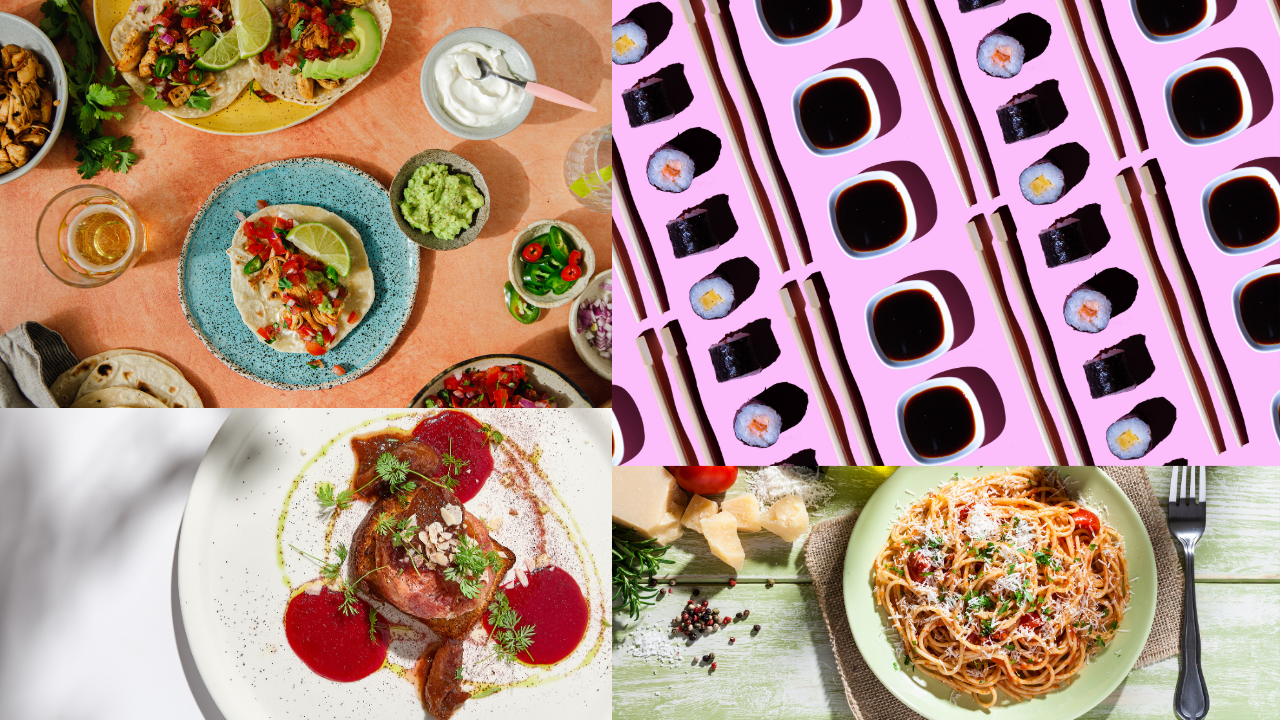
The restaurant concept tells customers what to expect before a single plate arrives. Italian fine dining, a Japanese omakase counter, a Mexican cantina, a French bistro, each carries a set of cultural expectations about pace, formality, and mood. The music has to honor those expectations or it creates friction. This guide breaks down how to match your background music to the specific cues each cuisine tradition signals to guests.
Quick take
- Cuisine signals cultural expectations. Music that contradicts those signals creates cognitive dissonance
- Tempo affects pace of eating. Slower music increases average spend per cover
- Italian and French call for warmth and familiarity. Japanese and Mexican need specificity, not generic approximations
- Avoid obvious clichés. Dean Martin for Italian or mariachi for Mexican feels like a theme park, not a restaurant
- Dayparting still applies. Lunch and dinner service need different energy even within the same cuisine
Why Does Cuisine Type Affect Music Choice?
Every cuisine carries cultural associations that diners bring to the table before they sit down. Italian means conviviality, generosity, time. Japanese means precision, restraint, attention to detail. Mexican means warmth, brightness, social energy. French means elegance, technique, unhurried pleasure. These associations are not arbitrary. They are built from decades of cultural exposure and they shape what feels congruent in the dining room.
When the music matches those associations, it reinforces them and elevates the experience. When it contradicts them, diners feel something is slightly off without necessarily being able to say why. That gap between expectation and experience is where hospitality fails quietly.
A 1999 study by North, Hargreaves, and McKendrick in the Journal of Applied Psychology demonstrated this directly: French accordion music in a wine shop increased French wine sales, while German oompah music increased German wine sales. Neither sign, menu note, nor staff recommendation changed purchase behavior the way ambient music did. The effect was congruence, not preference.
Music for Italian Restaurants
Italian dining at its best is about abundance and ease. The table is generous, the conversation is long, the pacing is unhurried. Music should reinforce that warmth without becoming a cliché.
The cliché to avoid: Dean Martin, Pavarotti, and Ennio Morricone on a loop. Every Italian restaurant in every airport in every country plays some version of that set. It signals nothing about your specific identity. It signals that you did not think about it.
What works instead:
- Fine dining and enotecas. Contemporary Italian jazz, acoustic folk from the south of Italy, slow neo-soul with Italian-language vocals. The goal is sophistication without stiffness. 70–85 BPM at dinner. Volume low enough that conversation across the table is effortless.
- Trattoria and mid-casual. Indie pop with Mediterranean warmth, bossa nova crossovers, classic Italian pop from the 1960s and 1970s used selectively. These feel authentic without the Dean Martin problem because they are specific rather than generic.
- Pizza and fast-casual Italian. Energy can climb. 90–105 BPM. Modern Italian indie, upbeat acoustic, funk-influenced Mediterranean sounds. The pace of service should match the energy of the music.
Music for Japanese Restaurants
Japanese culinary culture is defined by attention, craft, and restraint. The music has to match that register. Anything that feels cluttered, loud, or emotionally insistent is a mismatch.
The cliché to avoid: pan-Asian mood music. The category of vaguely Asian-inflected ambient that sounds like a spa in an airport is not Japanese. It is a Western approximation of "Asian calm" and diners who understand Japanese food culture will notice.
What works instead:
- Omakase and high-end sushi. Near silence with occasional sound. Japanese ambient and minimal electronic (Ryuichi Sakamoto, Hiroshi Yoshimura). Jazz at very low volume. The music should feel like it is barely there. The food is the event.
- Ramen and izakaya. Japanese city pop from the 1980s works exceptionally well here. City pop is sophisticated, specific, and has enough warmth and rhythm to support a more social atmosphere. 90–105 BPM. It is a genuine cultural reference, not a generic approximation.
- Modern Japanese casual. Lo-fi hip-hop with Japanese-language samples, contemporary J-indie, downtempo electronic. These work because they feel current and specifically Japanese without being kitsch.
Music for Mexican Restaurants
Mexican cuisine covers an enormous range: fast-casual taquerias, mezcal bars, upscale regional Mexican, beachside ceviche spots. The music strategy differs significantly across that range, but the common thread is warmth, rhythm, and social energy.
The cliché to avoid: mariachi as background music. Mariachi is performance music. It is meant to be the event. Using it as wallpaper in a non-performance context is the equivalent of playing a full orchestra recording at a dinner party. It overwhelms the room rather than supporting it.
What works instead:
- Upscale and regional Mexican. Contemporary Mexican indie and folk. Artists like Natalia Lafourcade, Carla Morrison, and Caloncho carry cultural specificity with genuine sophistication. 75–90 BPM at dinner. This is music that serious Mexican food culture actually listens to.
- Cantinas and mezcal bars. Cumbia, norteño, and Afro-Latin rhythms at a social volume. 95–110 BPM. The room should feel festive without tipping into chaotic. This is where a DJ-style approach to transitions matters, abrupt changes in energy kill the room's momentum.
- Fast-casual taquerias. Upbeat Latin pop, reggaeton at moderate tempo, Latin hip-hop. Match the energy of a busy, efficient service environment. 100–115 BPM.
Music for French Restaurants
French dining carries the strongest set of formal expectations of the four cuisines here. Technique, elegance, patience. The music has to honor that without becoming stuffy, and without defaulting to Édith Piaf on a loop.
The cliché to avoid: accordion-heavy French chansons as the entire program. Piaf and Brel are extraordinary artists. They are also the musical equivalent of a beret on the menu. Use them as accents, not as the foundation of the set.
What works instead:
- Fine dining and bistros with serious wine programs. French jazz (Django Reinhardt, Stéphane Grappelli), contemporary French electronic that nods to the Air and Daft Punk tradition, neo-soul with French vocals. 65–80 BPM. This is music that feels inherently French without being a museum exhibit.
- Casual French cafes and brasseries. More rhythm, slightly higher tempo. French pop, indie from the current Paris scene, bossa nova crossovers. 80–95 BPM. The atmosphere should feel like a good neighborhood in the 6th arrondissement rather than a tourist trap near the Eiffel Tower.
- Patisseries and French breakfast cafes. Light, warm, unhurried. Acoustic French folk, soft indie, jazz without brass-heavy arrangements. 70–85 BPM. Morning service calls for music that eases people into the day.
The One Rule That Applies Across All Four
Specificity always beats generic approximation. The mistake in every cuisine category is reaching for the most obvious cultural signifier and repeating it until it loses all meaning. What signals authenticity is depth. Not Piaf every hour, but a set that includes Piaf once alongside artists a French diner would actually recognize from a good Paris record store.
Our curation team has been building cuisine-specific scenes for hospitality operators for 26 years. The difference between a playlist that reinforces your concept and one that quietly undermines it is exactly this: knowing the difference between the obvious choice and the right one. That is what the curation process is built around.
Frequently Asked Questions About Cuisine-Matched Music
Should the music in my restaurant match the cuisine's country of origin?
It should match the cultural register and emotional expectations of the cuisine, which often means music from that country or tradition. But authenticity matters more than geography. Contemporary Japanese city pop is more appropriate for a ramen bar than generic pan-Asian ambient, even though both are technically "Asian." Specificity signals that you understand the culture, not just the category.
How loud should background music be in a restaurant?
At dinner service in a full-service restaurant, 65–70 dB is the right range. That allows conversation across the table without raised voices. Lunch service and fast-casual environments can sit slightly higher. The test: two people seated across from each other should be able to talk comfortably without leaning in.
Should I change the music between lunch and dinner service?
Yes. Lunch is typically faster-paced and more functional. Tempo can sit 10–15 BPM higher than dinner service. Dinner calls for a lower tempo and warmer sound to encourage longer stays and higher per-cover spend. This is exactly what daypart scheduling in a professional music platform is designed to handle automatically.
Is it legal to play music in my restaurant?
Only with the correct public performance licenses. ASCAP, BMI, SESAC, and GMR all need to be covered. Personal streaming services like Spotify are not licensed for commercial use and using them in a restaurant exposes you to copyright infringement claims. A commercial music service like Curator Now includes all four PRO licenses in the subscription.
What is the biggest mistake restaurants make with background music?
Defaulting to the obvious cultural cliché and playing it on repeat. Dean Martin for Italian, mariachi for Mexican, accordion chansons for French, generic pan-Asian ambient for Japanese. These choices signal that the operator did not think carefully about the music program. Guests who care about the cuisine will notice, even if they cannot articulate why.
Can the same playlist work for both Italian and French restaurants?
No. Italian and French dining carry different cultural expectations and different emotional registers. Italian calls for warmth and conviviality. French calls for elegance and restraint. Using the same music for both is the same mistake as using the same interior design for both. The details are what make a concept feel genuine.
References
North, A. C., Hargreaves, D. J., & McKendrick, J. (1999). The influence of in-store music on wine selections. Journal of Applied Psychology, 84(2), 271–276.
Milliman, R. E. (1982). Using background music to affect the behavior of supermarket shoppers. Journal of Marketing, 46(3), 86–91.